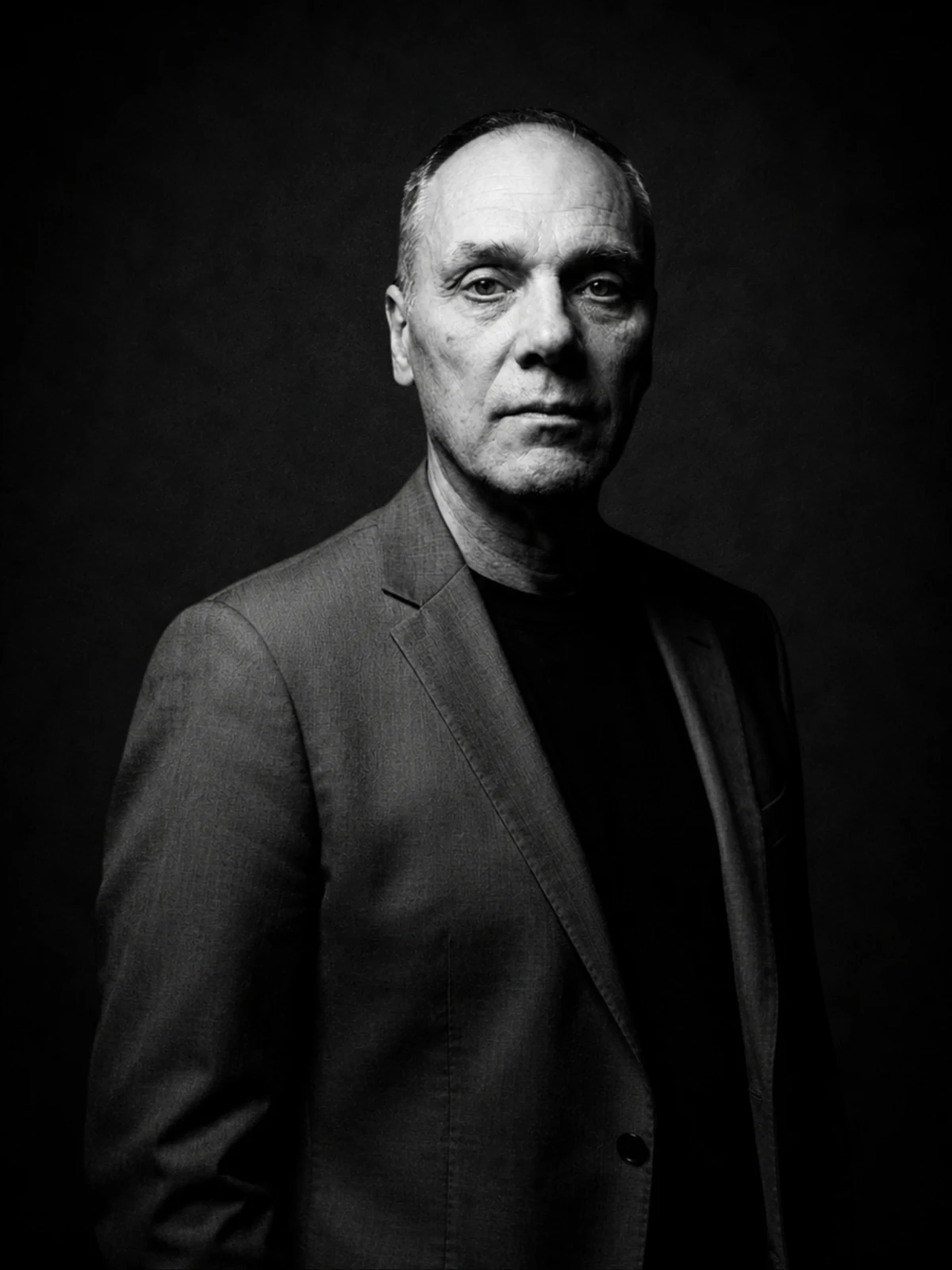
The Body Remembers
Ketil Eriksen is Danish. Self-taught as a painter, though he has taken painting courses throughout his life, he came to the studio by way of shipyards, stays in Yemen and Greenland, and many years employed by the Danish company Maersk — before coming ashore for good.
He works mainly in mixed media, oil and acrylic, and charcoal on canvas and paper, building in layers. There are no sketches and no photographic references. The canvas lies on the floor and he paints from above, using his whole body, though the work will be seen upright afterward. A black line almost always takes the leading role, with multiple colors layered around it.
He places himself in a lineage of minimalist abstract expressionism, naming Pollock and Twombly. Almost all of his works are titled simply Composition — as though the name were unnecessary before the layer, before the physics of a gesture that builds without predicting its result.
Eriksen paints without a plan, and this is not a lack of one. Nothing on the canvas can be traced back to an intention that preceded it, which means the work records exactly one thing: a gesture that happened once and cannot be repeated.
The floor is the method. Working from above with his whole body, he removes the distance that an easel guarantees — the painting is not in front of him, it is beneath him, and he is inside it. What arrives on the surface is not an image of movement but its residue. The black line, arriving again and again as the protagonist, is the only constant: a decision made in real time and left visible.
What W/ Soul recognizes in Eriksen is a painter who trusts the body over the mind. A life spent in shipyards, at sea, in Yemen and Greenland, precedes every canvas, and the work carries that history without illustrating it. He is proof that an exhibition is not a mirror of the curator. It is a window.
Ketil came to me as a recommendation from another artist — Ina — and recommendations rarely survive first contact with the work. This one did. It grew.
What holds me is that his painting is entirely of the body. No sketch, no photograph, no plan: he lies the canvas on the floor and moves over it, and what stays is what his body decided in the moment it was deciding. I recognize this from elsewhere in our roster — Cleidenil's hands that already know the way, after fifty years of sewing. Different material, different country, same truth. The work is an image of the artist's bodily memory, made visible only because someone finally stopped thinking and moved.
— The Curator