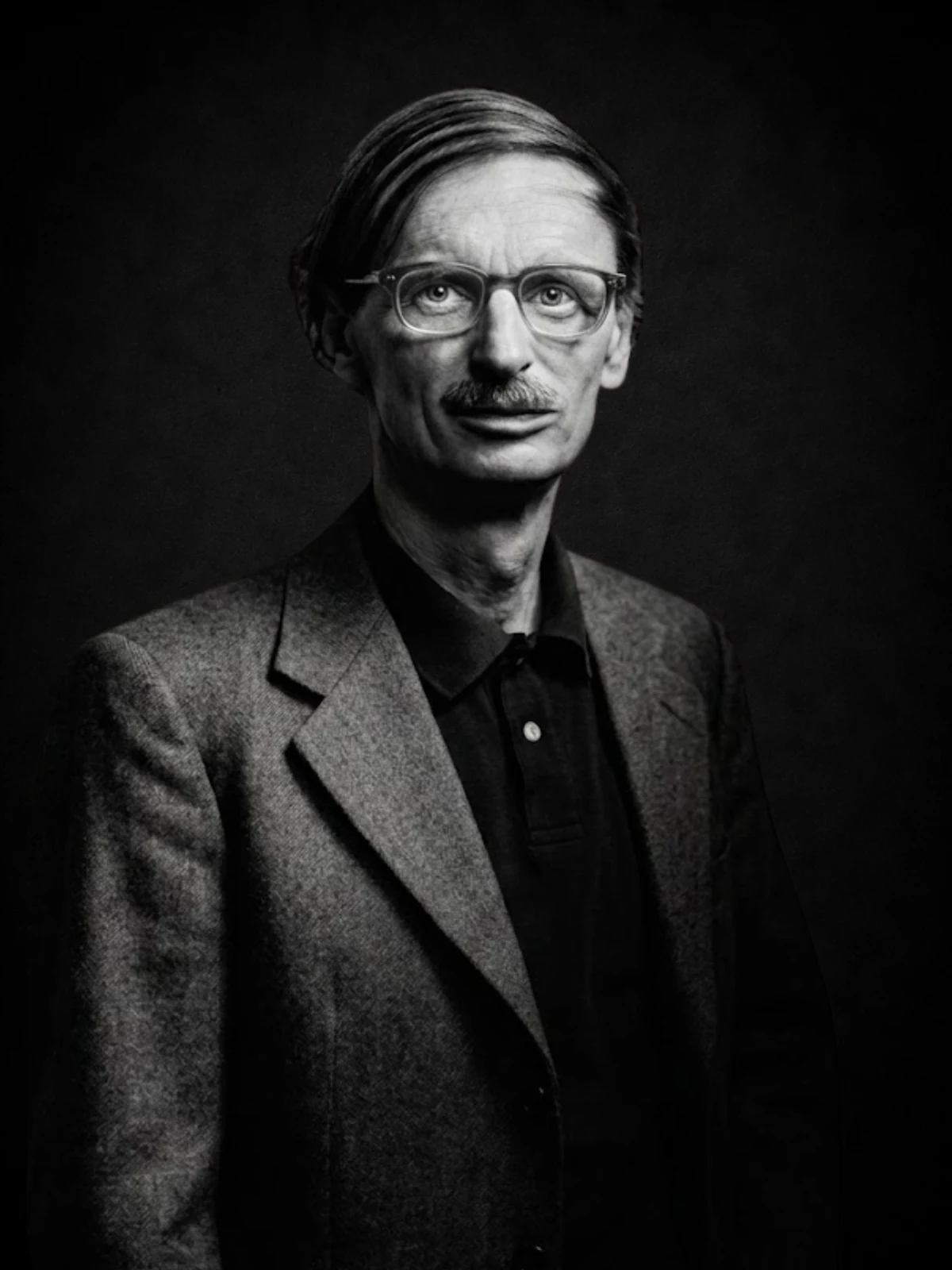
Some Work Simply Waits
J.K.S. Hohburg (Josef Konrad Senft, 1932–2002) was born in Hohenburg, in the Upper Palatinate, into a family of painters: his grandfather a master painter and gilder, his father the head of a painting workshop and mayor of the town for nearly two decades. He did not choose painting. He was born inside it.
He studied at the Akademie der Bildenden Künste München from 1950 to 1957 under Josef Oberberger, devoting himself to the structures of the human body. In 1957 he transferred to the Hochschule der Bildenden Künste Berlin to study under Karl Schmidt-Rottluff, co-founder of Die Brücke — and became his last Meisterschüler; the original 1960 certificate survives. That same year, still a student, he was a Vormitbegründer of Gruppe SPUR in Munich-Schwabing. In 1960 he founded the Kunstgruppe Vision.
He never sought commercial recognition. He remained outside the gallery circuit and simply painted, prolifically and obsessively, until his death in Munich in 2002; his last recorded diary entry is dated 26 October 2002. He left more than six hundred works. His paintings are held in the permanent collection of the Berlinische Galerie.
His technique was egg-linseed-oil tempera on raw, unprimed linen. Pure egg tempera dries fast and yields fine, luminous detail, but is brittle; pure oil allows broad, expressive strokes but dries slowly. The emulsion holds both: the yolk binds water and oil into a stable, flexible medium, the linseed oil extends the working time — a material that answers to precision and to impulse alike.
Hohburg had every condition required to be forgotten: a dense but poorly documented trajectory, an estate of more than six hundred works sleeping in silence, decades of absence from the circuit. He never left. The world simply stopped looking.
The painting refuses that forgetting. Placed beside contemporary work, a canvas of his from the sixties does not age — not because it is timeless in the vague sense, but because the pictorial quality continues to operate at full force. The color, the matter, the presence: they still do their work, sixty years after the hand left the surface.
The estate is managed on a single principle — catalogue first, narrate later. No biographical claim without a primary source, no publication without authorization. What W/ Soul recognizes in Hohburg is not a historical argument but an artistic one: the decision to bring him back did not come from the record. It came from standing in front of the paintings.
At ART MUC in 2025 a lady approached me about her father's work. In the middle of a fair — with works to show and a public to attend to — these conversations usually go nowhere. Something in this one held. Weeks later I wrote to her, and we arranged a coffee.
When I arrived at Friederike's home, I found she was practically living inside a gallery. Her father's paintings were everywhere, each more striking than the last. It was love at first sight — the kind only the discovery of a rare pearl can explain.
Then I did the research, and understood what I had walked into. Her father, J.K.S. Hohburg, was among the painters who helped bring art back to Germany after the wars, a member of two of the most significant groups of that period. The importance of it is what made me want to build the recovery project we are now, almost a year later, finally setting in motion.
He never stopped painting. The world stopped looking. Some work simply waits.
— The Curator