The Brazil That Lives in Silence
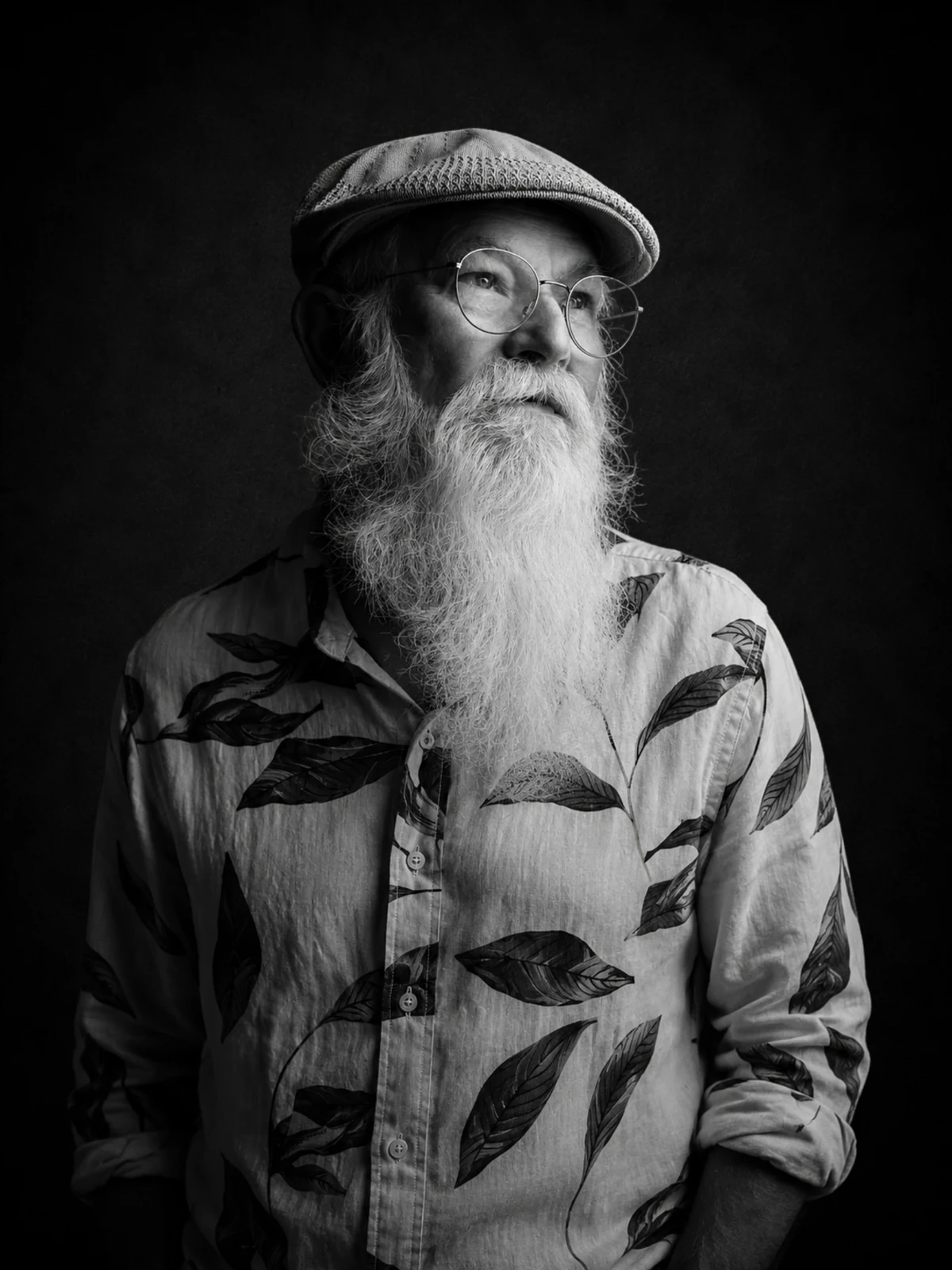
Jerci Maccari (b. 1949, Urussanga, Santa Catarina) grew up in the small rural town of Francisco Beltrão, surrounded by farmland, religious ritual, family tradition, and the quiet rhythms of country life. At thirteen he entered the Seminary of Ibicaré, where a humanistic and religious education shaped his sensitivity to the world. Later, in Pirassununga and São Paulo, he studied philosophy before devoting himself entirely to painting, finding under the mentorship of Sebastião Guimarães the intersection of technique and spirituality that would define his work.
His figures have no faces. The omission is an aesthetic position and a social gesture: by removing individual identity, Maccari honors rural workers as a community rather than as isolated subjects, and opens a space for the viewer to bring their own memory to the canvas. The figures become symbols instead of portraits — carriers of a collective identity, holding presence in gesture and posture rather than in features.
His lines are confident and bold, tracing the daily routines of the countryside: planting, harvesting, walking, caring. The colors are deep and saturated, drawn from the persistent memory of rural Brazil — sunsets over red soil, the heat of summer afternoons, the rustic hues of farmland and labor.
He does not paint landscapes. He paints memory. A landscape is observed from the outside; memory is inhabited.
Maccari paints a country that feeds the world and is rarely looked at. The fields, the harvest, the figures bent over the soil — these are not subjects chosen for visual appeal, but for moral weight. His paintings insist, quietly and without argument, that the people who do this work deserve to be seen.
The facelessness is the argument. Their dignity is not diminished by the absence of features; it is enlarged by it, made universal, made ours. What could have been documentary becomes something harder to dismiss: a figure that carries a whole class of lives without belonging to any single one.
What W/ Soul recognizes in Maccari is that his work does not create feeling — it finds it. The viewer never arrives empty. They come with their own fields, their own grandmothers, their own memory of an afternoon when ordinary light briefly turned sacred, and the painting locates what is already there and brings it to the surface without asking permission. That is why the work crosses distances it was never built to cross. You do not need to have grown up in rural Brazil to recognize what these figures carry. You need only to have loved a place, or lost one.
I found Jerci while searching for a painting of coffee growers. My parents have a small farm; coffee has always been part of our life. When I saw his work, it was not a painting I was looking at — it was a photograph in my mind. I saw my father. My mother. My aunt, working in the field. He had never met any of them, and there they were.
I wrote to him, and that is how this began. If Aristeo taught me to love art, Jerci taught me that I could live inside it — that a life could be built around the work, around the artists, around the act of bringing something like this to people who have never seen it. He is the patron of this gallery, and that is not an honorary title. It is a fact of origin.
Every time I stand in front of one of his fields, I am a boy again, watching people I love do work the world never thanked them for. He gave that memory a form it deserved. That is what painting is for.
— The Curator