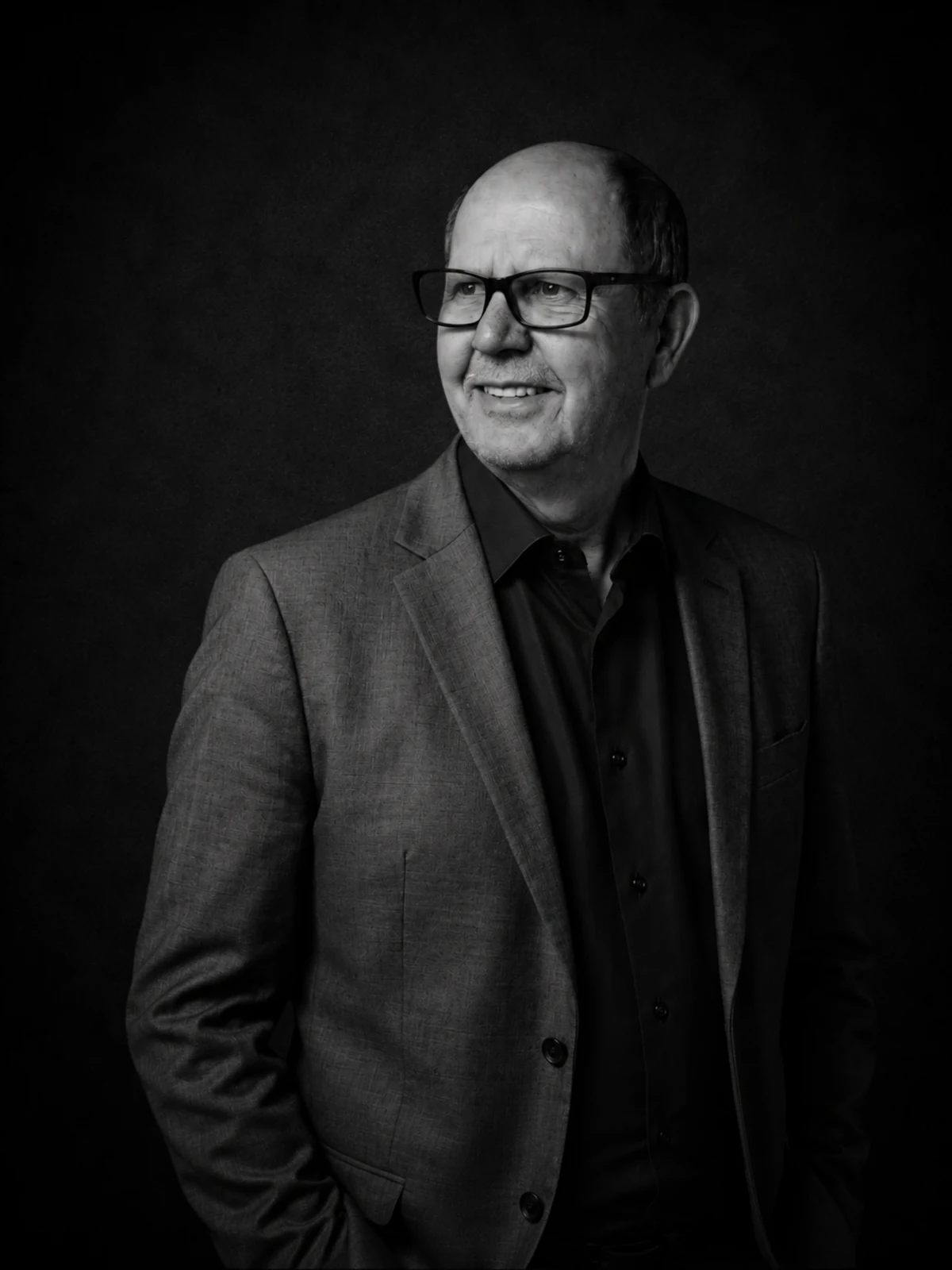
Forged in Silence
The sculptures of Aristeo Piovesan do not begin in iron. They begin in silence.
Aristeo J. Piovesan (1953–) is a sculptor based in Cianorte, Brazil, working in iron, reclaimed wood, and industrial scrap — always the discarded material, never the noble one. Entirely self-taught, he formed his hands not in an academy but through eighteen years restoring antique furniture in Embu das Artes, São Paulo, before returning to Paraná in 1989.
His most ambitious work stands in the open air, around the square of Cianorte's main church: a Via Crucis of fifteen life-sized stations forged in carbon steel, created between 2010 and 2012 for the Diocesan Eucharistic Shrine. Each station connects the Passion of Christ to a contemporary social reality — poverty, exclusion, the weight of labor — and asks the viewer to stand inside it. Faith, social reflection, and a quiet political conscience run through everything he makes.
His process is a conversation between control and surrender. He does not impose a form on the material; he proposes one — and listens. Cutting, welding, assembling, repainting: each piece is an act of recomposition, instinctive yet precise, in which imperfection is not corrected but kept — as presence.
A rusted beam carries the memory of the structure it once supported. A twisted rod holds the energy of the force that bent it. His sculptures do not erase these histories — they amplify them: compositions charged with time, labor, and spatial emotion.
Since 2025, his work has also been shown in Munich, where it speaks a language he never needed to translate.
Nothing is truly discarded. Only waiting.
Piovesan's path did not pass through any academy. It passed through eighteen years in an antiques workshop in Embu das Artes, restoring what others had abandoned; through the return to Cianorte and a Via Crucis of fifteen stations that now anchors the city's main square; through a decision, followed without exception ever since, never to choose the noble material when the discarded one still has something to say.
His sculptures inhabit the squares and streets of Brazil — seen by thousands, recognized by few. And still, he continues. This persistence is not stubbornness: it is the conviction that a sculpture standing in a public square has already fulfilled its purpose, regardless of who names or catalogues it. Few artists embody so literally what W/ Soul understands as cultural permanence — work that exists beyond the exhibition, beyond the market, beyond its own name.
His work was not born of purchased steel. It was born of what remained of something else. And still it left the interior of Paraná to stand in Bavarian castles and European art fairs — carrying the weight of a lifetime that never asked for permission. It left Cianorte as iron. It arrived in the world as feeling.
For more than thirty years, my father has been a friend of Aristeo Piovesan and worked in his atelier in Cianorte. It was in that workshop of iron and wood that I saw art for the first time — before I knew it had a name. W/ Soul was born from that instinct: learning to look before naming.
When I hold one of his sculptures in Munich, I am not holding only iron. I am holding the smell of that atelier, the patience of a man who listens to the material before cutting it, and the proof that what is made with honesty does not stay in one place. Aristeo does not need recognition to continue — but I needed the world to see him. This gallery began there, even if neither of us knew it at the time.
— The Curator